· Howard Young · blog · 6 min read
Seventy Times Seven: The Parable of the Unmerciful Servant
A sermon on Matthew 18:21–35: why Jesus answered Peter's question about forgiveness with a parable about a debt no one can repay — and a King who cancels it.
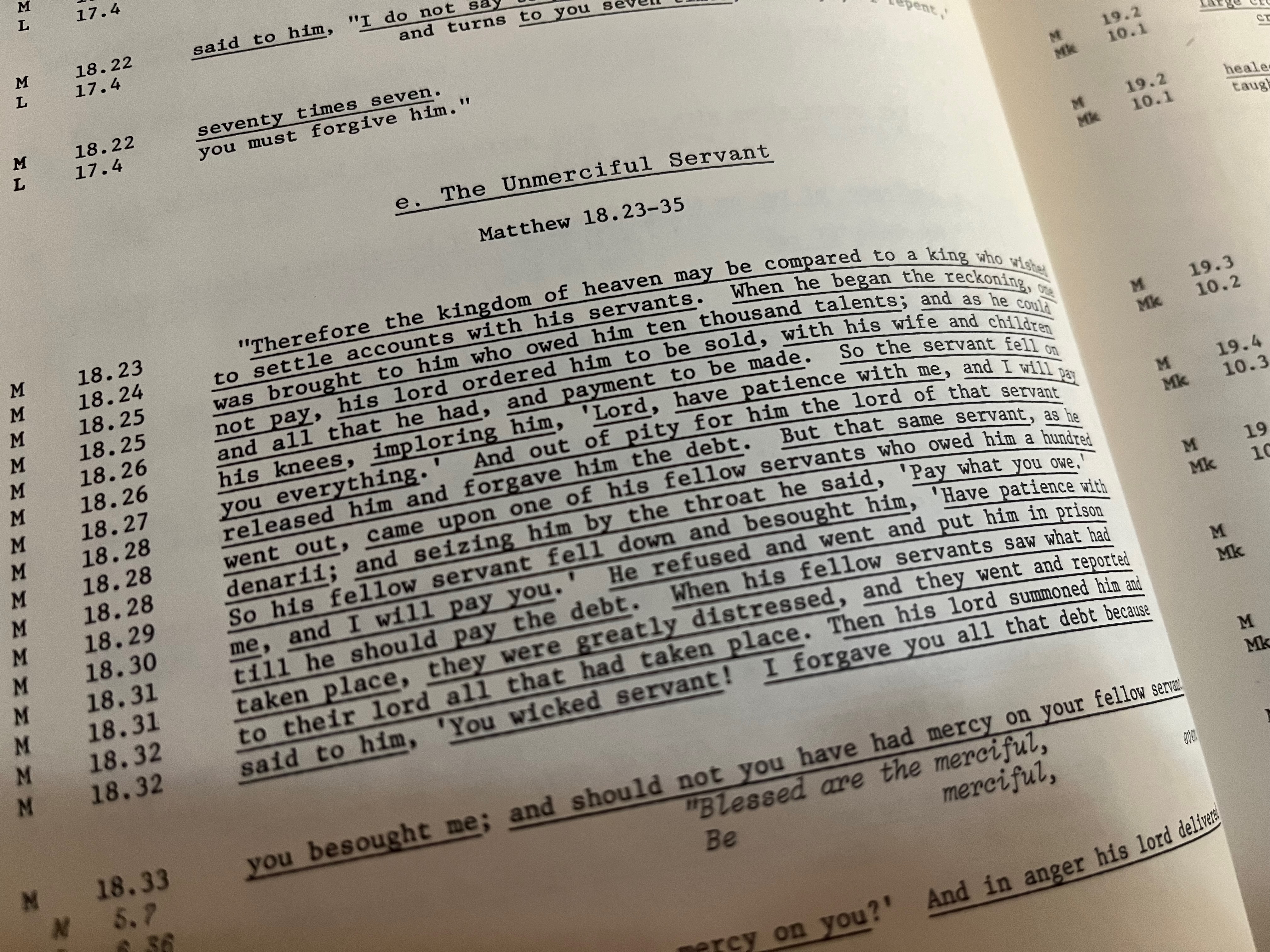
Sermon - September 13, 2026
In the name of the Father, Son and Holy Spirit. Amen.
The Fourth Discourse
It amazes me how today’s Gospel reading of Matthew 18:21-35 brings back memories of my Introduction to Christianity course at California Lutheran College some 40 years ago.
Every Friday, Dr. Reuben J. Swanson gave a multiple choice quiz. There were several closely related questions on The Unmerciful Servant.
- Was it a Parable or Allegory?
- Who was the King?
- Who was the Servant?
- Which Discourse was it in?
- What other Gospel was it in?
- Did what other Discourse is it related to?
All were trick questions and if you missed the lecture, you probably got the answers wrong even if you read the scripture lessons for the week.
The Parable of the Unmerciful Servant is a parable that is found in the Fourth Discourse of Matthew. It is unique to Matthew and not included in any of the other Gospels.
The author of Matthew used a framework of five discourses similar to the five books of Moses to illustrate Jesus as the “New Moses” whose words and deeds establish the new covenant with God.
The New Community
The Fourth Discourse parallels the Old Testament Book of Numbers.
- Who is the Greatest? 18.3b-4
- Receiving Children 18:5-14
- Forgiveness: 18:15-22 (last week’s Sermon)
- The Unmerciful Servant: 18:23-35 (this week’s Sermon)
Seventy Times Seven
The parable does not begin with a king and a servant. It begins with a question from Peter.
“Lord, how many times shall I forgive my brother or sister who sins against me? Up to seven times?” (Matthew 18:21)
Peter thought he was being generous. Seven was already beyond what tradition required. But Jesus answers: “I tell you, not seven times, but seventy-seven times”. (Matthew 18:22)
Jesus is not setting a higher quota. He is abolishing the quota entirely. Seventy times seven is not a number you can reach. It is a way of saying: stop counting.
And then, to show Peter — and us — why limitless forgiveness is not just an ideal but a necessity, Jesus tells the parable.
This is why our worship does not begin with praise or announcements or even scripture. It begins with Confession and Forgiveness.
The liturgy opens with the whole congregation acknowledging together what the first servant refused to see in himself — that we are people who owe a debt we cannot pay. We speak it aloud, not as individuals whispering in private, but as a community: “against you, you alone, we have sin. In your compassion, cleanse us from our sin…” We do not come before God pretending otherwise.
And then comes the absolution — the pastor’s formal pronouncement of what the king did for the servant in the parable. Not a suggestion that God might forgive. Not a conditional pardon. A declaration: “In the mercy of almighty God, Jesus Christ was given to die for you, and for his sake God forgives you all your sins.”
This is the shape of seventy times seven. Week after week, year after year, we return to the beginning — not because forgiveness wears out, but because we do.
We forget what we have been given. We close our hands around what we owe. Our confession and forgiveness is the practice that keeps the parable alive in us, reminding us before we do anything else that we are the servant who has been forgiven an impossible debt.
The Characters in the Parable
So back to Dr. Swanson’s trick questions. Who is the King? Who is the Servant? This is where the parable opens up into something much larger than a moral lesson about paying your debts. Each figure in the story represents a reality we already know from our own lives — and from the Gospel.
| Character | Represents |
|---|---|
| The King | God — the one who holds our debt and has the authority to forgive it entirely |
| The First Servant (the unmerciful one) | Each of us — forgiven an unpayable debt, yet slow to extend that same mercy |
| The Fellow Servant | Our neighbor — the brother or sister who has wronged us, whose debt to us is small by comparison |
| The Other Servants | The community of faith — witnesses to how we treat one another |
| The Torturers | The consequence of a closed heart — the burden we carry when we refuse to forgive |
The debt the first servant owed the king was ten thousand talents. With a talent being roughly 20 years of work, this impossible debt would never be paid off.
No one reading this parable would have thought repayment was realistic. Not even Elon Musk. That is precisely the point. The debt stands for sin, and the king’s decision to cancel it entirely is sola gratia (grace alone), unearned and undeserved. What the servant receives is not a payment plan. It is a pardon.
The Lord’s Prayer Connection
This parable does not stand alone. It is an illustration of words Jesus had already taught his disciples to pray.
In Matthew 6:12, the Lord’s Prayer reads: “And forgive us our debts, as we also have forgiven our debtors.” Matthew uses the same Greek word here — opheilēma, debt — that runs through the parable. The language is not accidental. Jesus is saying: the prayer you pray every day, that petition about debts and debtors, is exactly what this story is about.
The parable puts flesh on the petition. The king canceling ten thousand talents is what it looks like when God forgives us our debts. The servant refusing his fellow servant a hundred denarii is what it looks like when we fail to forgive our debtors. And the outcome — the king’s anger, the servant handed over to the torturers — is what Jesus warns follows when the two halves of that prayer come apart.
Immediately after the Lord’s Prayer in Matthew 6, Jesus adds: “For if you forgive other people when they sin against you, your heavenly Father will also forgive you. But if you do not forgive others their sins, your Father will not forgive your sins.” (Matthew 6:14–15). The parable of the Unmerciful Servant is, in many ways, the extended telling of that same warning.
Closing
Next Sunday we will do what we do every Sunday. We will walk in, find our seats, and before the first hymn is sung, we will speak together the words of Confession.
“We confess that we are captive to sin and cannot free ourselves.”
And absolution will come. It always comes. Not because we earned it, but because that is who God is — the King who runs toward the servant, cancels the debt, and restores what was lost.
We are that servant. Every week we forget, and every week the liturgy brings us back. Every week the debt is canceled again — not because it was not enough the first time, but because we need to hear it again. We need to stand in that throne room again and remember what we owe, and watch it be erased.
Amen.
- Faith
- Gospel
- Scripture
- Discipleship