· Howard Young · blog · 3 min read
John 14:15-17 'If Ye Love Me': A Choral Experience
Thomas Tallis wrote 'If Ye Love Me' in the 1500s, setting John 14:15-17 for four voices. Singing the tenor part a cappella is as challenging as it is spiritually moving.
There is something otherworldly about a piece of music that has moved people to tears for nearly five centuries. Thomas Tallis wrote If Ye Love Me in the 1540s, and it remains one of the most luminous examples of Renaissance choral writing ever set to paper.
The Text: John 14:15-17
The words come directly from John 14:15-17, where Jesus speaks to his disciples on the night before his crucifixion:
If ye love me, keep my commandments. And I will pray the Father, and he shall give you another Comforter, that he may abide with you for ever; Even the Spirit of truth; whom the world cannot receive, because it seeth him not, neither knoweth him: but ye know him; for he dwelleth with you, and shall be in you.
Tallis set these words for four unaccompanied voices: Soprano, Alto, Tenor, and Bass (SATB). The harmonies are deceptively simple on the page and extraordinarily difficult to hold in the room.
Singing the Tenor Part
I was fortunate to sing the Tenor part of this piece at Holy Trinity Lutheran Church in Thousand Oaks, California. Singing a cappella — without any instrumental accompaniment — demands that every singer carry the pitch entirely from memory and from the voices around them. There is nowhere to hide and no safety net below you.
Virginia Walters, our accompanist, would “spell” our notes before we began: playing each voice’s opening pitch so the ensemble could find its footing before the first word was sung. From there, it was the four parts weaving together, each line dependent on the others to stay true.
What struck me most was what happened inside the music itself. Immersed in the melody and harmonies, I could feel the Spirit there, guiding us toward the next notes, steadying the pitch, holding the chord together. It was not imagination. It was exactly what the text describes: an advocate, present, abiding.
At the end of each rehearsal, our accompanist would play the final chord after we finished, not to accompany us, but to reveal whether we had stayed on pitch through the whole piece. The moment of that chord landing in tune was its own small grace.
Why This Piece Matters
Music like this is a reminder that worship has always had a physical dimension. Singing together in parts requires listening, yielding, and trusting the voices beside you. It is, in miniature, what the church is called to be.
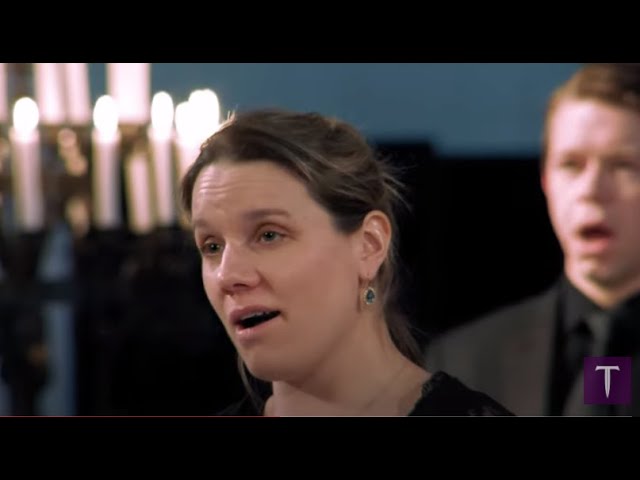
The video above features Tenebrae, conducted by Nigel Short — one of the finest recordings of this piece you will find. Listen with good headphones and a quiet room.
If you have ever sung in a choir, or longed to, this is the piece that will make you want to try.
- Faith
- Scripture
- Lutheran
- Gospel