· Howard Young · blog · 9 min read
Seeing Is Not Believing: The Feeding of the Five Thousand
A low-probability encounter with a British TV star and the miracle that fed five thousand share a common thread — some things must be experienced to be believed.
Grace and peace to you from God the Father, Son, and Holy Ghost.
Amen.
When your family has a business, the children are often expected to help out. Pick up a broom, sweep the floor, take out the trash — and of course, appear in TV commercials.
My brother and sisters were no exception, except that I enjoyed working at the Buffalo Robe. I started there when I was about 7 and worked for another 15 years until I graduated from college. I learned about the trade, my Native American heritage, and once in a while got to meet famous actors like Brian Keith and Charlton Heston. My sister was excited to meet members of the Mamas and the Papas. I think she still has the album they gave her.
During my college years I worked every Saturday. It gave my mother a day off, and it was nice to get a home-cooked meal.
Our schedule was very routine: open at 9:30, close at 5:00, lock the door and close the books. We had a strict policy — no one came in after the door was locked.
Mom had dinner waiting for us when we arrived.
After supper, my dad and I would watch our favorite BBC thriller, The Professionals. It was a spinoff of the MI5 crime division, starring Martin Shaw, Lewis Collins, and Gordon Jackson as agents of the CI5. Lewis Collins played the part of “Bodie,” a cool, James Bond-type character. He was the star of the show — he made everything click together, and he always saved the girl.
It was a hot summer in ‘83 and business was slow that Saturday. I was glad it was 5:00 and I walked to the front door and locked it. We were looking forward to heading home and watching The Professionals. Would Bodie save his girlfriend? That had been the discussion for most of the day.
We were right in the middle of closing the books when someone knocked on the door.
My dad and I both ignored him.
He was persistent, which caused me to look up.
My dad was surprised when I went to the front door and let him in. “It’s after 5,” he said.
I opened the door.
In a very polite British accent, the man said, “I’m here in the States on holiday. I’m so glad I didn’t miss you — we fly back to England tomorrow.”
I said, “Mr. Collins — er, Bodie — I’m glad you stopped in to see us.”
He was taken aback that we knew who he was. He had been in the States for three weeks and we were the only ones who recognized him.
My mother was angry. We were late, dinner was cold. She thought we were in an accident. She didn’t believe our story.
My dad showed her the autographed photo of Lewis Collins that read, “To Phil and Howard, my biggest fans in the USA.”
My mom responded, “And that’s why we have a strict ‘close the door at 5’ policy.”
The Feeding of the Five Thousand
You may be wondering what this has to do with the feeding of the five thousand.
Basically, both stories are true — and many fathers and sons went home that night too full to eat supper. I’m sure they got the same stern look my mother gave us.
But there is a deeper connection. My mother didn’t believe us — not because she thought we were lying, but because a random encounter with a British TV star after closing time on a summer Saturday is so improbable that disbelief is the rational response. You had to be there.
A crowd of five thousand, fed from five loaves and two fish? That is not improbable. That is impossible — and yet it happened. Seeing is not believing. Believing is what opens your eyes.
How the Four Gospels Tell the Story
All four Gospel writers record this miracle, and each one draws our attention to something different.
Matthew (14:13–21) focuses on church order. He emphasizes that Jesus works through the disciples: Jesus gives the food to the disciples, and the disciples give it to the crowd. That chain of distribution is deliberate — the church is an ordered community through whom Christ distributes his gifts, not a crowd pressing in on a performer.
Mark (6:30–44) reaches for the imagery of Psalm 23. He notes the green grass and the organized groups of fifty and a hundred. Mark is painting a portrait of the Good Shepherd leading his flock to green pastures. The miracle is not chaos; it is tender, ordered care.
Luke (9:10–17) places the miracle immediately after the disciples return from preaching the Kingdom of God. The timing is intentional. The meal is a foretaste, a preview of the heavenly banquet that Jesus described in his parables. Every time the Kingdom is proclaimed, a feast follows.
John (6:1–14) sets the scene at Passover and reaches back to Elisha’s miracle in 2 Kings 4, where a servant fed a hundred men with twenty barley loaves and had some left over. John is telling us: something greater than Elisha is here. This is the New Exodus, and Jesus is the bread that comes down from heaven — not manna that perishes, but himself.
Multiple Miracles in One
What happened that day was not a single miracle. It was several, woven together.
The Miracle of Faith
Martin Luther wrote extensively about this passage in his sermons on the Gospel of John, and he calls our attention to a moment we might otherwise rush past. In John 6:5–7, Jesus turns to Philip and asks, “Where shall we buy bread for these people to eat?” John tells us that Jesus asked this to test him, for he already knew what he was going to do.
Philip’s answer is immediate and practical: it would take more than six months’ wages to buy enough for each person to have even a bite. The math was correct. Philip got the numbers right. But Philip’s faith was small.
The feeding of the five thousand is not only bread from nothing. It is faith — the kind that does not begin with “how much will this cost?” but with “Lord, what would you have us do?” When we place what little we have into Jesus’ hands, God provides. Not necessarily in the way Philip would have planned. But always.
The Miracle of Daily Bread
Most of us have prayed the Lord’s Prayer so many times we no longer hear what we are asking: “Give us this day our daily bread.”
Luther, in the Small Catechism, asks what “daily bread” means. His answer is wonderfully expansive. Daily bread includes everything the body needs — food and drink, clothing, shelter, land, a livelihood, peace, good government, and all other earthly blessings. Luther did not spiritualize away our physical hunger. He took it seriously, because Jesus took it seriously.
The feeding of the five thousand is God answering that prayer in real time, in the open air, before thousands of witnesses. The same Jesus who holds the cosmos together is not indifferent to the crowd’s hunger. He sees it. He provides. He feeds.
The Miracle of Communion
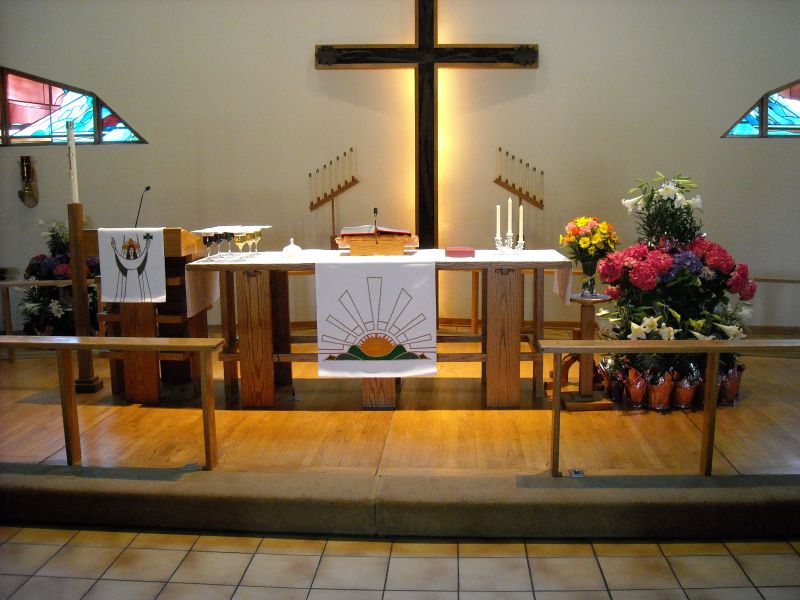
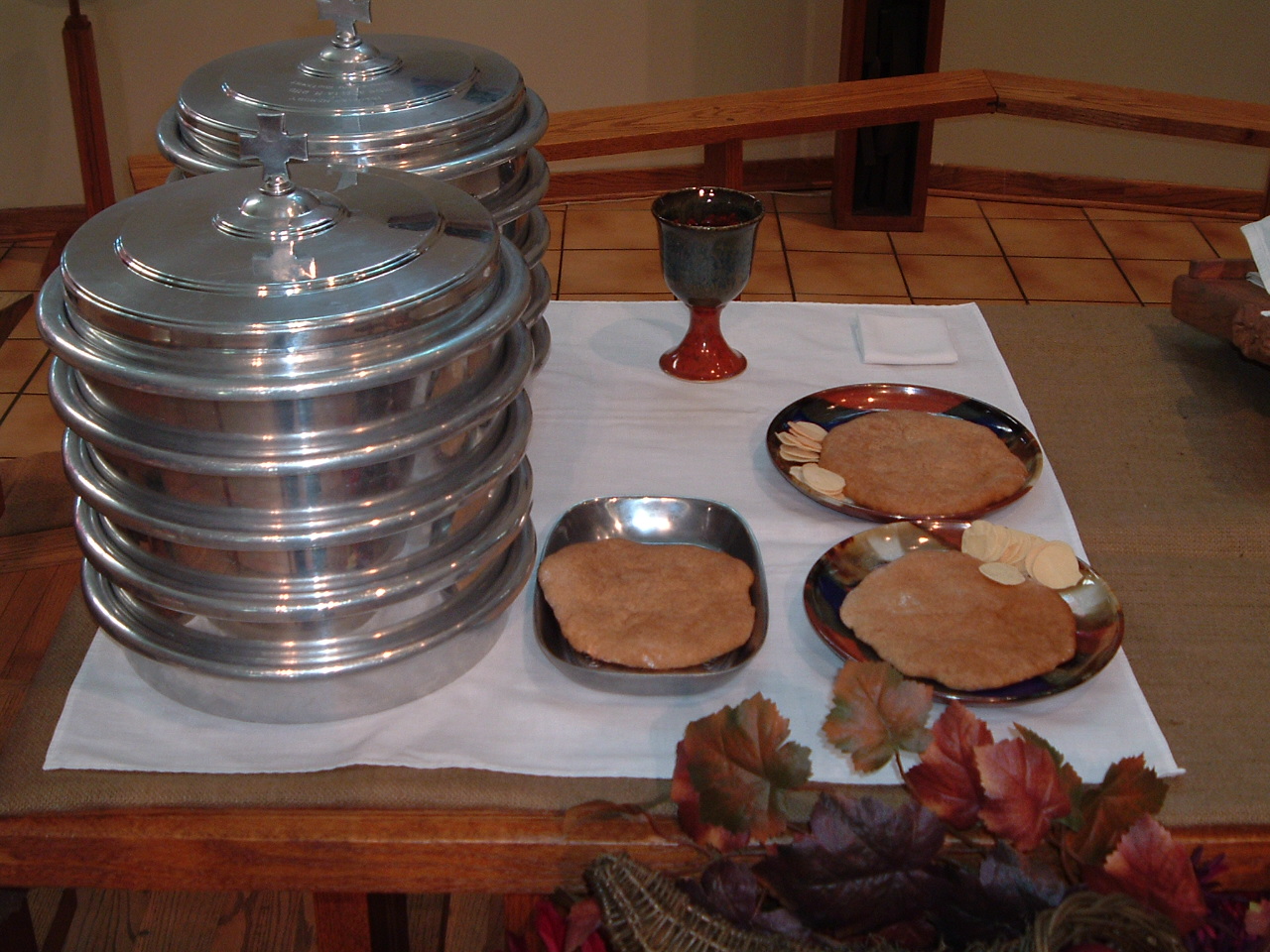
I am always a little astonished that a small loaf of bread can feed so many during the Sacrament. On busy Sundays when visitors fill the pews, I quietly wonder if we will run out. We never do.
There is something of the five thousand in every Communion service. When the elements are blessed and distributed, Christ’s presence is here with us. The same Lord who gave the bread to his disciples and told them to distribute it to the crowd now gives himself to us under bread and wine, through the hands of our pastors and lay ministers. We do not come to a memory. We come to a table where the host is truly present.
Very much like the disciples who carried the meal from Jesus’ hands to the waiting crowd, our pastors and lay leaders distribute to the flock what Christ himself has given. The miracle of the five thousand has not stopped. It happens at this altar every Sunday.
The Miracle of Generosity
Only John tells us where the bread and fish actually came from: a boy. A small boy with five barley loaves and two fish — poor people’s food, the cheapest grain — who handed everything over.
Matthew, Mark, and Luke do not specify the source; the food simply appears from among the disciples. But John zooms in on this unnamed child, and the detail matters. He did not calculate the odds. He did not ask what he would eat if the plan failed. He simply offered what he had.
Jesus took it, gave thanks, and it was enough. More than enough. Twelve baskets of leftovers — one for each apostle, one for each tribe of Israel. The surplus of grace.
The miracle of generosity is not the abundance at the end. It is the surrender at the beginning.
Conclusion: Believing Is Seeing
Lewis Collins was gracious enough to sign that photo for my dad and me. But my mother, even with the evidence in hand, remained skeptical. Some things you have to be there for.
That is the nature of miracles. You cannot manufacture faith by accumulating enough evidence. You cannot argue someone into trust. Faith, as Paul writes, comes from hearing — hearing the word of Christ (Romans 10:17).
The feeding of the five thousand is not asking you to believe in a magic trick. It is asking you to trust the same Jesus who, in the wilderness, looked at five thousand hungry people and did not say, “That’s not my department.” It is asking you to trust that the one who multiplied the loaves also multiplies his grace — that he takes what little we offer, gives thanks, breaks it, and distributes it through the hands of his people, until everyone has had enough and twelve baskets are left over.
Seeing is not believing. But when you believe, you begin to see it everywhere: in a loaf of bread passed from hand to hand, in a cup shared at the rail, in a community that somehow always has enough to give.
There is always enough.
There are always twelve baskets left over.
Amen.
- Scripture
- Faith
- Communion
- Miracles
- Matthew 14
- Daily Bread
- Sermon