· Cindy Manning · blog · 10 min read
Free by Grace: A Reformation Sunday Sermon on John 8:31-36
Cindy Manning's Reformation Sunday sermon on John 8:31-36: God's grace is a free gift, and the truth of his Word sets us free to love boldly.
Sermon delivered October 25, 2026, Reformation Sunday — John 8:31-36
Grace, mercy, and peace be with you from God our Father and our Lord and Savior, Jesus Christ. Amen
Today is Reformation Sunday, and I wanted to find a short poem to share with you. So, in my lack of wisdom, I typed in my browser, “Short Reformation Poems.” In just a few seconds, a short little poem appeared. It goes like this:
The Hammer and the Door
A quiet monk with heavy heart,
Upon an autumn day,
Decided grace was not for sale,
Nor peace a price to pay.He nailed a parchment to the wood,
A spark against the night,
To call the church from gilded pomp
Back to the ancient light.No coin can buy a soul released,
No ledger stay God’s hand;
By faith alone the spirit lives,
By grace we firmly stand.
I really liked it, but it didn’t reference an author. Typically, even if it’s by an unknown author, it will state as such. So, I go down the rabbit hole of trying to find the author. I must have spent 20 minutes or more chasing this little poem. No luck. Then I decide to type in the entire poem into my browser to find a reference to the writer. Once again, Google responded: The text you shared is an AI-generated poem typically created by large language models (like ChatGPT, Claude, or Gemini) when prompted to write a short, original poem about Martin Luther and the Protestant Reformation. The giveaway is in the introductory phrase itself: “here is an original, short poem inspired by….,” which is a standard programmatic response format used by AI assistants when fulfilling a creative writing request. I look up in the corner, and sure enough it states: Here is an original, short poem inspired by the historical Protestant Reformation.
Then it goes on to say: “The poem beautifully captures the core historical elements of the event”:
- The quiet monk: Refers to Martin Luther
- The Autumn Day: Luther famously nailed his 95 Theses to the door of All Saints’ Church in Wittenberg on October 31, 1517 (All Hallow’s Eve)
- The gilded pomp & coins: Refers to Luther’s protest against the Catholic Church’s sale of indulgences (buying forgiveness).
- By faith alone / By grace: Highlights Sola fide and Sola gratia, two of the foundational theological pillars of the Reformation.
Then it further insults me by asking if I would like to generate another original piece.
Reformation Is Something God Is Continually Doing
Now on with my sermon: Reformation Sunday – It is a day when we remember Martin Luther, the 95 Theses, and a movement that began more than 500 years ago. But Reformation Sunday is not simply a day to remember something that happened in the past. It’s not something we take out of the closet and look at it once a year.
Reform means to make changes to make improvements, to amend what is wrong, corrupt, or unsatisfactory. Reformation, to us, means something is being renewed or made new. Reformation in our lives is something God is continually doing. He does this in our church, our communities, in our relationships, and in each and every one of us. You and me.
In Jeremiah we hear this promise: “I will put my law within them, and I will write it on their hearts; and I will be their God, and they shall be my people.” God is telling us that he will love us deeply. He’s not asking us to prove ourselves or do great works to earn his love. No, he says he will forgive us and remember our sins no more. Let me repeat what He says again: “I will be their God, and they shall be my people.” We know we are sinners; we know that although we are made in the image of God, we are not perfect as He is, yet He says he will forgive us and remember our sins no more. God comes near to all people. Not just the wealthy, not just those in power; no, he comes to all people, no matter where or who they are. Regardless of economic class, ethnic background, or sexual orientation. He sees all as his children. With that, he sees our best and our worst. Yet, he still says: “You are my people.”
Paul says the same thing in a different way in his letter to the Romans. All of us have sinned. All of us have missed the mark. None of us can earn our way into God’s love. None of us can prove that we are worthy enough, faithful enough, productive enough, or good enough to deserve grace. That is good news, because God’s grace was never something we could earn in the first place. It is purely a gift. There’s that word again: GRACE. We as Lutherans understand it fairly well, yet we need to be reminded from time to time exactly what it means.
Grace and the Holy Spirit
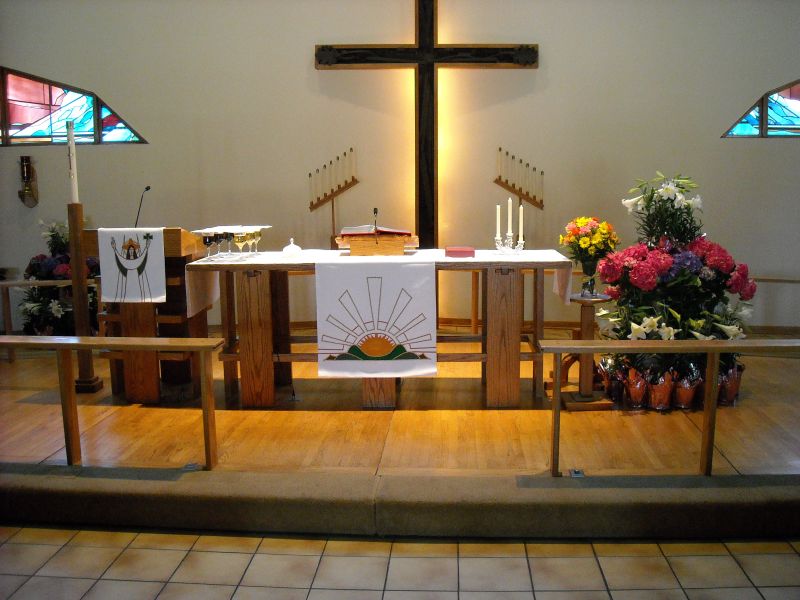
If we look today at the paraments on the altar and lectern, we notice a few things. The cloths are the color red. Why do we wear red today? Why are there embellishments of fire depicted on the paraments? Tongues of fire. Those tongues are the power of the Holy Spirit. The Holy Spirit that we were baptized in, along with God the Father and God the Son. Let us be reminded of the connection of the Holy Spirit to Grace. Joyce Meyer describes it as the following: “Grace is the power of the Holy Spirit coming into our life to enable us to do with ease what we can never do with any amount of struggle and effort on our own.” In other words: “The Holy Spirit is the living presence and divine power that delivers, applies, and manifests God’s grace in the life of a believer.” A believer, like you and me.
When we talk about grace alone without works, I want to be clear that we are not off the hook with doing good works. We should always try to do good for others. And as I’ve said before, our congregation does good works. We care. We help. We love. God expects us to continue to work in the vineyard. But that work, while expected to be done to the best of our abilities, is not what saves us; no, it is grace through faith. The gift of faith sparks a relationship we are invited to tend and nurture and tend and nurture over and over again. We do this by worship, scripture, and prayer. We tend it through forgiveness. Through loving our neighbors as ourselves. We tend it when we come to the table and receive the promise that has been given to us through Christ’s suffering and all that was given for us. We tend it by seeing God’s work in the world. We see it by standing up for justice and fighting injustice.
When we nurture that relationship, we are reformed. It turns us toward response. It gives us freedom. We become free from the feeling that we must be everything to everyone.
Before you carry out a single thing, you are loved and valued. You are worthy of God’s love because he’s had you in the palm of his hand from the very beginning.
The Truth Will Make You Free
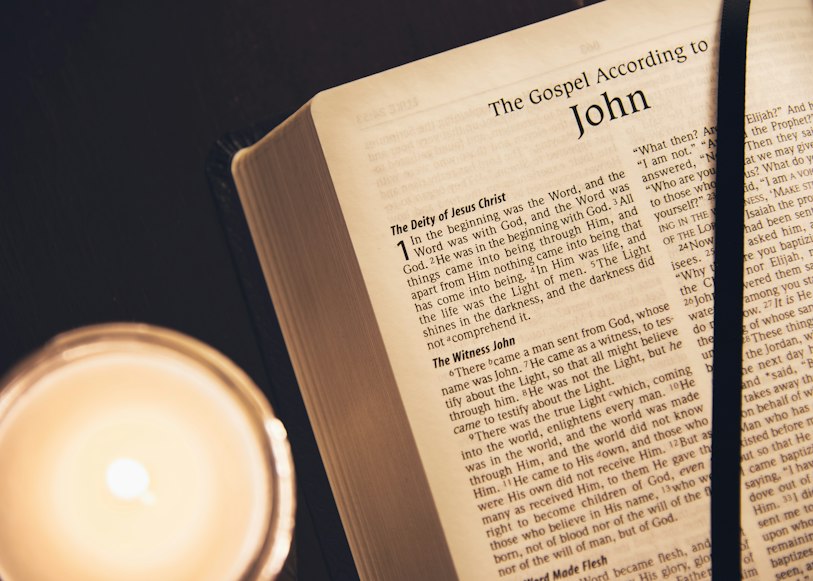
In John’s Gospel, Jesus says: “If you continue in my word, you are truly my disciples; and you will know the truth, and the truth will make you free.” (John 8:31–32) What is that freedom? From the beginning, John has been telling us: “In the beginning was the Word, and the Word was with God, and the Word was God.” (John 1:1) All things came into being through this Word. That freedom allows us to love deeply and boldly. We are freed to forgive and accept forgiveness. We are free to give of ourselves. To sit with those around us who are hurting. Who are lonely or hungry. It frees us to work with and for our communities. We are free to take risks that are faithful. We are free to do that, knowing that we will sometimes fail, yet knowing the Word of God is our safety net. It is our comfort to know that God’s love and grace will always be there to catch us.
We hear of this freedom in Psalm 46. The mountains shake. The waters rage and foam. The nations rage and kingdoms shake. Sounds a bit difficult, doesn’t it? It sounds a bit familiar, doesn’t it? In a time when there is division, conflict, suffering, and fear, it can feel like all we hear is bad news, depressing news. But right there in the midst of the shaking mountains and raging waters, God says, “Be still, and know that I am God.” Be still; he sees us, and he hears us.
This doesn’t mean we ignore what is around us, not because pain doesn’t matter. The psalm tells us that God is present in the midst of it all. God invites us to trust, to stop, and to release our fear. To understand and remember who God is. To remember we are not alone. That Jesus walks beside us always. Perhaps in the midst of all the noise, we are reminded that he invites us to hear and receive the truth again: You are loved, you are his. You are forgiven. You are free. Once we accept that, perhaps our vision becomes clearer, and we can see what needs to be changed. Perhaps then reformation continues.
As our congregation moves forward in our own reformation or “changes,” we need to have faith and remember the scriptures tell us to hold steady: in the love, in the prayers, and in abiding in the word of God. Whatever the outcome in the long term for Triumphant Cross, it is God’s will, on God’s timetable, and is moved forward by the Holy Spirit. Remember that each of us matters in the eyes of God, and his love is amazing.
The Three Solas
Let us remember the three main core principles of the Reformation, known as the “Solas.”
- Scripture Alone: The Bible is the only source of divine revelation. Placing Scripture above human works.
- Grace Alone: Salvation is not earned by human merit or good works. It’s a gift from God, and it’s FREE. It’s a response of God’s grace and not the result of human effort.
- Faith Alone: People are justified and saved through faith in Jesus Christ alone, not through the works they perform. It’s a personal connection between the believer and Christ.
This is not a reformation of ideas alone. It is a reformation of our hearts. It begins with our experience of living in this truth: We are loved, seen, and valued by God–and so is everyone else. Every single person. Even the person we struggle to understand. Even the person with whom we disagree. Even the person the world overlooks. From the least to the greatest, God says, “I will be their God, and they shall be my people.” (Jeremiah 31:33–34)
Let us pray,
Dear faithful Lord. We thank you for the truth of the Gospel and for renewing our hearts through the Holy Spirit. Help us to remain steadfast in your word, to have courage, to strengthen our faith, and to live in the freedom of your Son, Jesus Christ. Grant us strength to reform in your image, to love you and to love our neighbors. We ask this in the name of your Son, Jesus Christ our Lord.
Amen
- Reformation
- Grace
- Lutheran
- Scripture